I'll Never Smile Again
Solo piano · recorded 1955MIDI file
€10.99
VAT included · instant download after checkout
Secure Stripe checkout with cards, iDEAL, PayPal, Apple Pay and Google Pay. Your invoice is emailed automatically.
Included in your purchase
- Erroll Garner - I'll Never Smile Again (1955).mid
- Practice mode on transcribe, with tempo control, the A-B loop and the Sheet music tab
- Your invoice, by email and in your library
- Free re-downloads from your library, at any time
The preview video shows exactly what is in the MIDI file, left hand and right hand visualized.
Practice mode preview
First 30 secondsFull duration: 5:27 · unlocks after purchase
This file is licensed for your personal practice and study. Please do not use it commercially, for example in a monetised video, a public performance, a stream or a release, without approval first. If that is what you have in mind, reach out via the contact page and we will sort it out.
I'll Never Smile Again is Ruth Lowe's song rather than one of Garner's own, and it was written in grief. She had married Harold Cohen, a Chicago music publicist, in 1938; he died of kidney failure during an operation the next year, and she went back to Toronto and wrote it in her apartment. It went out first on Canadian radio in a Percy Faith arrangement and reached Tommy Dorsey through his guitarist, Carmen Mastren. Dorsey passed it to Glenn Miller, whose record came out on 12 April 1940, then cut it himself with Frank Sinatra and the Pied Pipers on 23 May. Released on 7 June, that record was number one on Billboard's first National List of Best Selling Retail Records, the first official national chart, on 27 July 1940, and stayed there for twelve weeks. The Ink Spots recorded it that August, Billie Holiday and Sinatra again in 1959, the Platters in 1961, and it entered the Grammy Hall of Fame in 1982.
Garner recorded it alone, at Fine Sound in New York on 14 March 1955, for Mercury, and it came out that year on Solitaire, an album named for another tune cut the same day; A Cottage for Sale, That Old Feeling, Over the Rainbow, It's the Talk of the Town and Then You've Never Been Blue are from the session too. It sits between Misty, which he had written the year before, and Concert by the Sea, recorded that September in Carmel, California and one of the best-selling jazz records of its decade. This is Garner alone, the self-taught player who never read music, with no bass and no drums under him: the orchestral manner of his reputation, left hand strumming four to the bar, right hand behind the beat, with both hands carrying the pulse as well as the tune. The Mercury track runs 5:23; the file runs 5:27, the whole of it.
The transcription follows the performance note for note, with the two hands on separate MIDI tracks: 3,433 notes in 5:27, 1,978 of them on the right and 1,455 on the left, and the sustain pedal written in, 340 events of it. The separation earns its keep in the crossings. The left hand runs from B flat 0, near the bottom of the keyboard, up to A flat 6, and the right from F2 to G7, so the two ranges overlap across more than four octaves, and which hand owns a note in the middle of the piano is settled by the track rather than guessed. The key reads as D flat major, with the opening third in B flat minor, its relative minor, before the major takes over. The left hand can be taken on its own until the pulse under the ballad is steady, then the right put back over it at any tempo, so you can slow the runs down without the time drifting.
- Artist
- Erroll Garner
- Genres
- Jazz Ballad Piano, Jazz Piano
- Recorded
- 1955
- Difficulty
- Intermediate
- Duration
- 5:27
- Tempo
- about 125 bpm
- Key
- D flat major
- Channels
- 2 · left and right hand
- Format
- .mid · Type 1
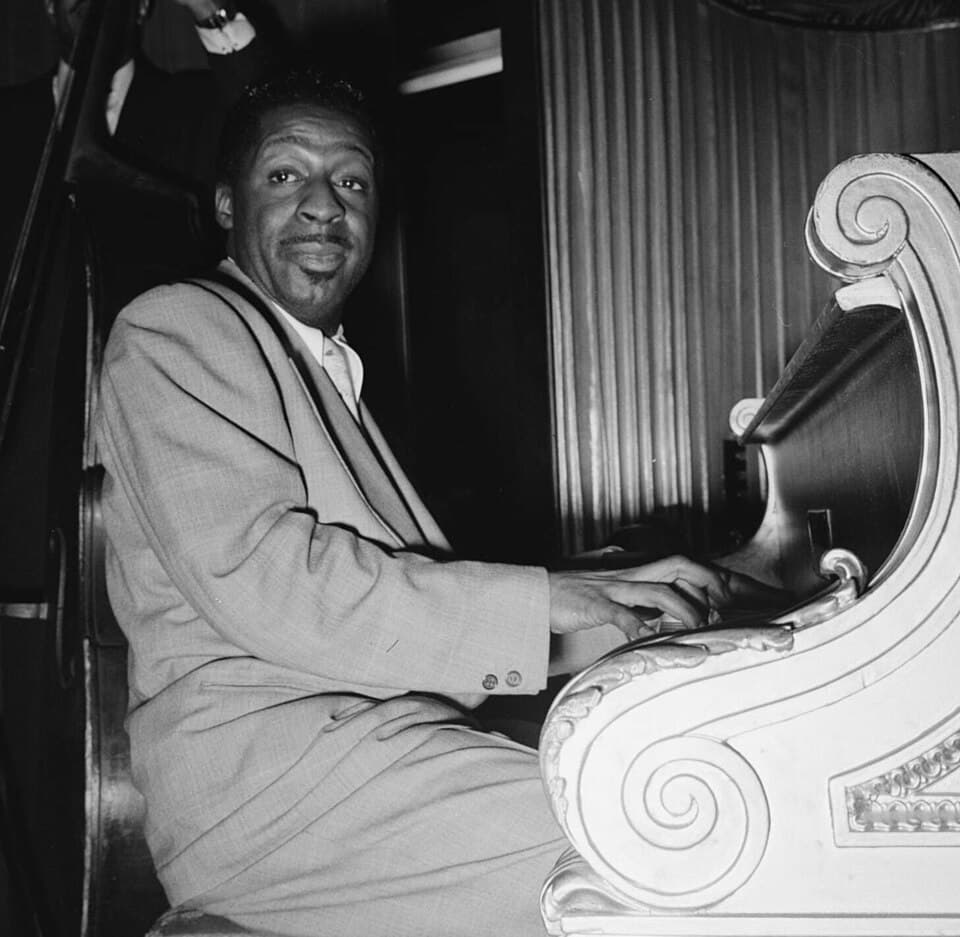
Erroll Garner
Erroll Garner, the self-taught composer of Misty, swung like a full orchestra: left hand strumming steady fours like a rhythm guitar, right hand floating just behind the beat. He never learned to read music and never needed to.