Composer
Scott Joplin
1 transcription, every one with separated left and right hands.
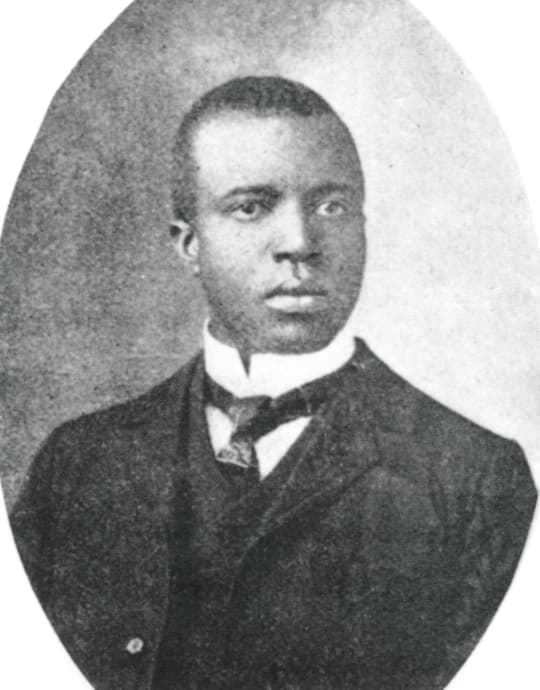
Scott Joplin
Scott Joplin (c. 1868-1917) was born in northeast Texas, the son of a father who had been enslaved and a freeborn mother. The family settled in Texarkana, where a German-born music teacher, Julius Weiss, gave the young Joplin a grounding in classical technique and opened his ear to European opera. That schooling stayed with him. He treated ragtime not as novelty dance music but as a written art, closer in ambition to a Chopin mazurka than to the saloon tunes of the day.
By the mid-1890s he had reached Sedalia, Missouri, where he played at the Maple Leaf Club. His "Maple Leaf Rag" of 1899 sold steadily for years and gave him a rare independence for a Black composer of the era. "The Entertainer" followed in 1902, and the two pieces carried his crisp left-hand bass and singing, syncopated right hand into parlors across the country. Later generations rediscovered them, most famously when "The Entertainer" scored the 1973 film The Sting.
Joplin's deepest ambition was opera. He poured his last years into Treemonisha, a work about a young woman who leads her community toward learning, but he managed only a bare concert reading in Harlem in 1915 and died in 1917 without seeing it fully staged. A Pulitzer Prize arrived posthumously in 1976. His rags reward patient study: slow a recording down, or open a transcription in practice mode, and the careful voicing beneath the tunefulness comes clearly into view.